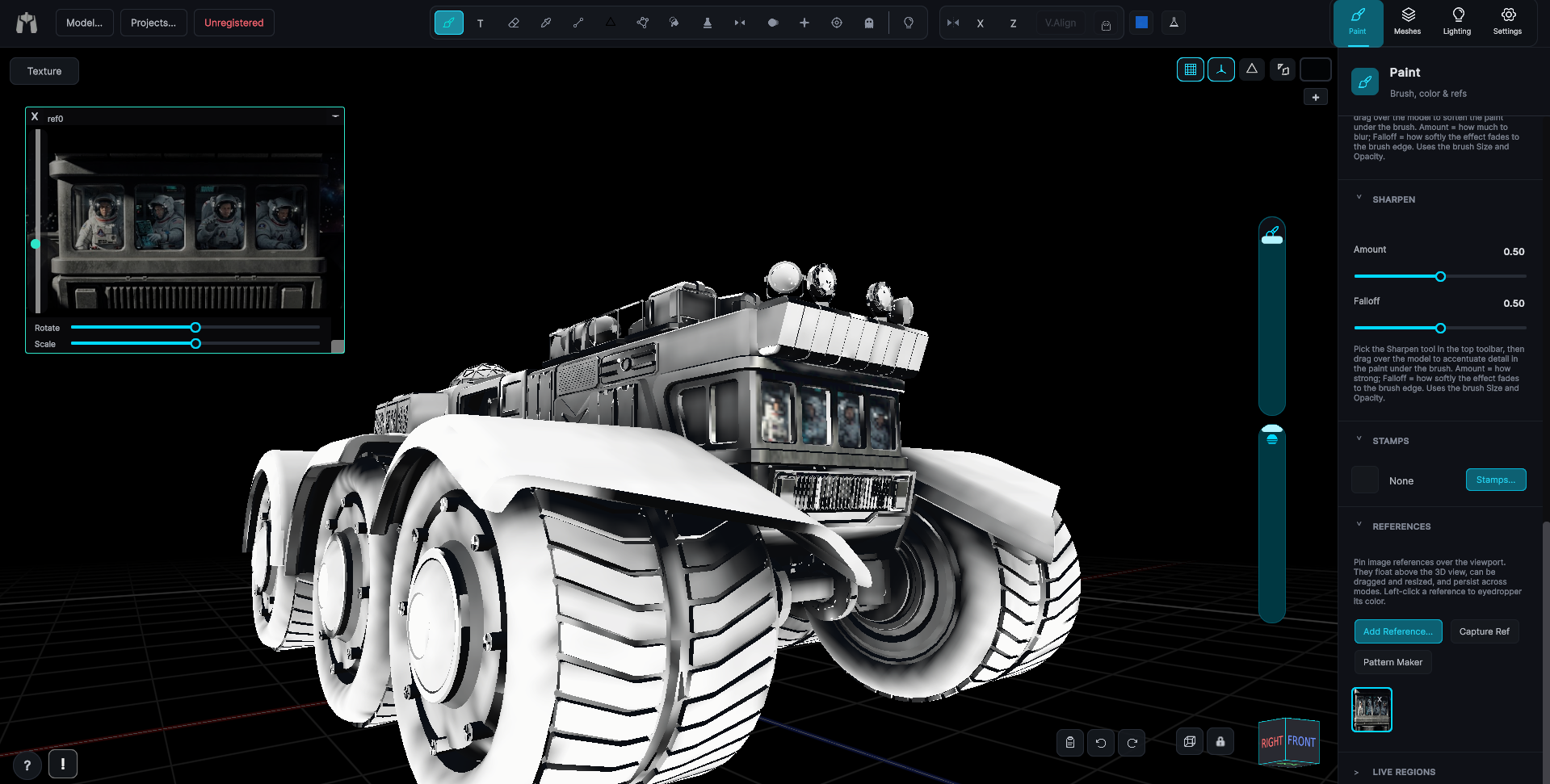
Multiverse Brush
Pick another layer as the source, then brush its pixels onto the active layer.
Hover first to see through to the source where a stroke would land, then brush to transfer it. The source layer can be hidden, which is what makes this useful: keep a variant out of sight and paint it back in where you want it. Painting one mesh with the surface of a completely different mesh, with no shared topology or UVs, may well be a first for 3D painting. Of course, that only matters if it gets the detail you want onto your model faster, and it does.
Option bar
- Source - A dropdown listing every layer, top of the stack first. The active layer is dimmed, since it is the destination. Hidden layers are marked hidden and can be picked. Under OTHER SOURCES it also offers the loaded reference mesh, and Image file, which opens a file picker.
- Size - 0.001 to 1.0 world units. The same Size the other brushes use.
- Hard - 0 to 1. Edge hardness of the transfer, from a soft feathered edge to a crisp one. The preview circle shows this same edge.
- Opacity - 0 to 1. How strongly the source pixels are laid down. The stroke is shaped by Size, Hardness and this alone, so the source layer's own opacity and blend mode stay out of the transfer.
- Status - An amber line naming whatever is stopping a stroke: "Pick a source layer", "Source layer was deleted, pick another", "Source is the active layer, pick another", "No reference mesh loaded", or a stale cache line asking you to pick the reference again.
The hover preview
The circle under the cursor renders the source's pixels onto the surface where a stroke would land. It is display only: it is never composited and never becomes an undo step, and it obeys exactly the same gates as the stroke, so if the preview shows nothing the stroke would paint nothing.
Notes
- An image source is sampled at this model's own UVs, with no bake. A reference mesh source is projected and needs a correspondence bake, which runs with a progress dialog.
- The source choice lives for the session.
- The first time the bar opens in a session it picks a default source: the reference mesh if one is loaded, otherwise the bottom layer.
- A stale correspondence cache, after rebuilt UVs, a UV transfer, a slot merge or a model reload, is reported in the status line rather than silently rebaked. Pick the reference again to rebake it.
- Multiverse Brush is built for the desktop.